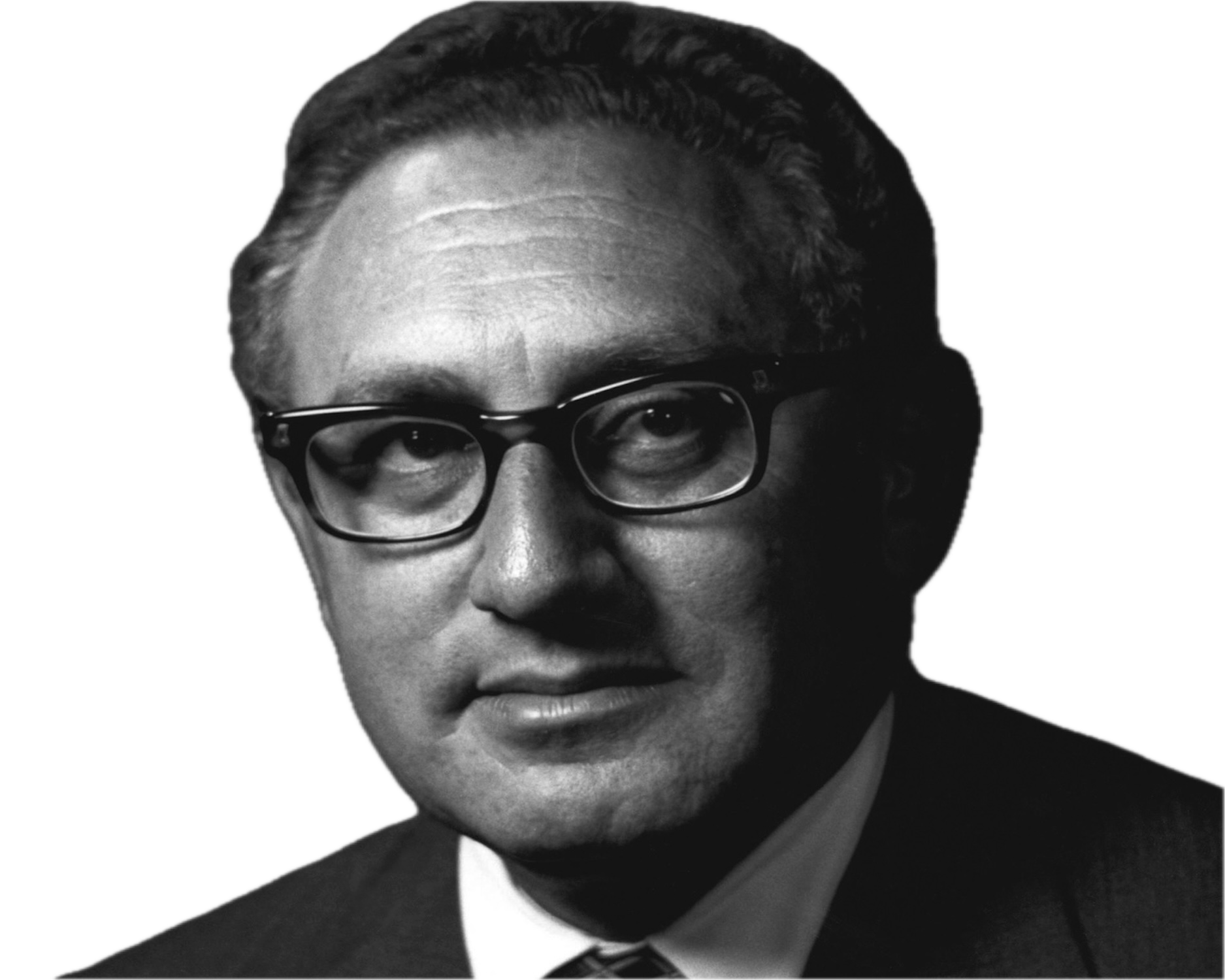
// Henry Kissinger · National Security Advisor 1969–1975 · Secretary of State 1973–1977 · Nobel Peace Prize 1973
Henry Kissinger was the 20th century's most consequential practitioner of classical realism in government. Drawing directly from Morgenthau's national interest framework, Metternich's Concert of Europe, and Bismarck's manipulation of great-power alignments, Kissinger constructed a foreign policy architecture based on balance, linkage, and the systematic management of great-power competition. His opening of China, détente with the Soviet Union, and negotiation of the Paris Peace Accords reshaped the strategic map. The structure he built — US-China-Soviet triangular deterrence, arms control agreements, Helsinki process — held the international order together for four decades. Understanding how that structure was assembled is essential for understanding how it is coming apart.
Heinz Alfred Kissinger was born May 27, 1923, in Fürth, Bavaria. His family emigrated to the United States in 1938 to escape Nazi persecution. After serving in the US Army and working in military intelligence during and after World War II, Kissinger pursued a Harvard doctorate under William Yandell Elliott. His dissertation — later published as A World Restored (1957) — analyzed the Concert of Europe system constructed by Castlereagh and Metternich after the Napoleonic Wars. This historical case study became the intellectual foundation of his entire approach to statecraft: legitimate international order requires that major powers accept the system's basic rules, that no state is permanently excluded, and that the dominant power manages rather than eliminates its rivals.
Kissinger rose to prominence through his work on nuclear strategy — Nuclear Weapons and Foreign Policy (1957) made him the first strategic thinker to argue seriously for limited nuclear war as a viable policy option. This work brought him into the national security policy community as a consultant to successive administrations. Nelson Rockefeller's failure to secure the 1968 Republican nomination ended Kissinger's connection to his primary patron; Richard Nixon's election brought him to power as National Security Advisor, with a mandate to restructure US foreign policy from the White House rather than State Department.
Triangular diplomacy. Kissinger's most original strategic contribution was the deliberate management of the US-China-Soviet triangle as an interlocking pressure system. By opening relations with China in 1972, Kissinger did not create a US-China alliance — he created a new variable in Soviet strategic calculations. Moscow now had to worry about a possible US-China alignment against it, which changed the incentive structure for Soviet-American negotiations across every domain. The triangle was a deterrence architecture built from diplomatic relationships rather than military deployments.
Linkage. Kissinger's operational method was linking disparate issues across domains — trade, arms control, regional conflicts — into negotiating packages where progress in one area was conditioned on Soviet behavior in others. The theory was that the USSR needed enough from the United States (technology, trade, recognition) that it would moderate its behavior in exchange. Linkage required discipline — the willingness to withhold concessions in one domain to extract behavior in another — and it required that the adversary believe the conditionality was real.
Concert of Powers. Kissinger's deepest conviction, derived from his study of Metternich and Bismarck, was that stable international order requires a concert of major powers who accept the system's legitimacy even when they disagree on specific issues. Revolutionary powers — states that reject the existing order entirely — cannot be accommodated; they must be isolated or transformed. Status quo powers — even adversaries — can be managed through negotiation, balance, and the provision of stakes in the system's continuation. Détente with the USSR was an attempt to give Moscow enough stakes in the existing order that it would choose competition within the system over confrontation against it.
Kissinger translates the theoretical framework of classical realism — Morgenthau's national interest, Waltz's structural logic — into operational statecraft. EIR draws from him the practitioner's insight that realism is not just an analytical framework but a decision-making discipline: the systematic prioritization of power and interest over ideology, the willingness to negotiate with adversaries without sentimentality, and the recognition that the structure of great-power relations matters more than the character of individual leaders.
The Kissinger system's unraveling since 2016 is directly relevant to EIR's current analysis. The triangular US-China-Soviet order he constructed has been replaced by a US-China bilateral competition that lacks the triangular balancing mechanism — Russia is now aligned with China rather than positioned between the two superpowers. The linkage strategy requires a trading partner with enough at stake in the relationship to modify behavior; China's economic integration with US markets provided that stake, but decoupling reduces it. The Concert requires that the dominant power maintain legitimacy and manage rivals through inclusion rather than exclusion; the shift to zero-sum framing undermines it. Understanding what Kissinger built is essential for understanding what tools are no longer available.